What Is Cheiro Numerology - And Why It's Different From Other Systems
Cheiro numerology is a number-based system of character and destiny reading built on the Chaldean letter-value chart. It was practiced and published by the Irish astrologer and palmist known as Cheiro in the early 20th century, and it predates the Pythagorean numerology almost every app defaults to today.
Most numerology tools online never mention this distinction. If you've calculated a "Life Path Number," you've used Pythagorean counting -alphabetical, simple, and the industry default because it's the easiest to code. Cheiro numerology isn't that.
Across most numerology apps and sites, the sloppiness around which system is actually being used is worse than it should be. Most don't say. A few that claim "Chaldean" quietly run Pythagorean math underneath and never notice. Numin doesn't blend the two - no Life Path number appears anywhere in the app, on purpose.
Who Was Cheiro?
Cheiro was the professional name of William John Warner, later known as Count Louis Hamon, an Irish palmist, astrologer, and numerologist who practiced from the 1890s until his death in 1936. His name came from cheiromancy, the older word for palm reading.
He wasn't a fringe figure. Cheiro built one of the most prominent society practices of his era, reading palms and charts for Mark Twain, Oscar Wilde, Sarah Bernhardt, Thomas Edison, and Grover Cleveland, among many others. He kept a guest book at his London office where clients recorded their own reactions - Mark Twain's entry survives: "Cheiro has exposed my character to me with humiliating accuracy."
Some of his predictions are documented and dated. He forecast that the Jewish people would return to Palestine and that the nation would once again be called Israel - decades before the state of Israel existed. His reading of William Pirrie, chairman of the company that built the Titanic, warned of a coming "fight for his life," a detail later revisited after the ship's sinking.
By his own account, Cheiro learned Chaldean numerology, palmistry, and astrology during an extended stay in India as a young man, studying under practitioners who worked with a far older number system than the one most people encounter today. He published that system in 1926 in Cheiro's Book of Numbers. That among his other works are direct sources for every calculation Numin performs.
Cheiro Numerology vs. the System You've Probably Seen
Most numerology apps and websites use Pythagorean numerology, which assigns letters to numbers in simple alphabetical sequence: A=1, B=2, C=3, and so on through I=9, then the cycle repeats. It's easy to explain and easy to code, which is likely why it's the default in most numerology software.
Chaldean numerology works on a completely different principle. Rather than counting letters in order, it assigns each letter a number based on its vibrational sound value - a phonetic logic inherited from ancient Mesopotamian tradition, predating the Pythagorean system by centuries. The Chaldean table only uses the numbers 1 through 8. The number 9 is treated as sacred and never assigned to a letter directly - it only ever appears as a final, reduced result.
This letter table is often called the Cheiro numerology chart. Here's Cheiro's actual chart, exactly as published:
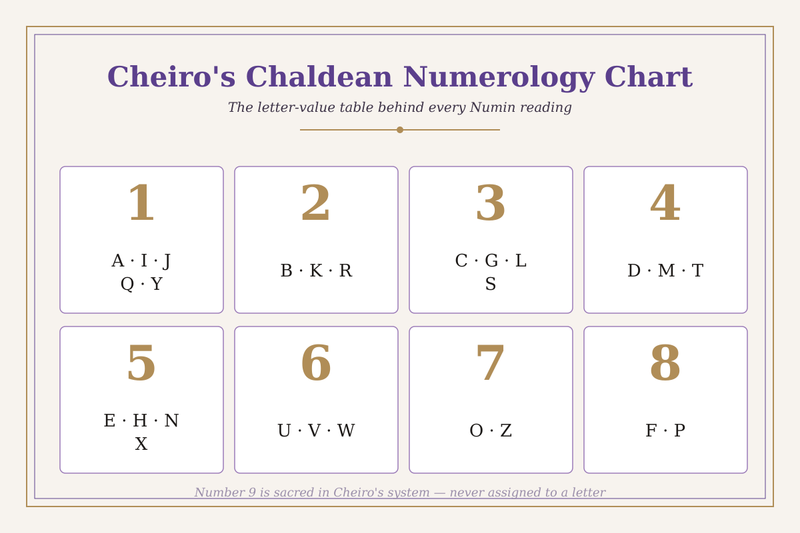
Run the same name through both systems and you'll often get different numbers. That's not a rounding error - it reflects two genuinely different traditions with different origins, and conflating them (as many modern apps quietly do) muddies both.
How Cheiro Numerology Actually Works
Three calculations sit at the core of Cheiro's system, and they're the same three Numin builds every reading around:
Birth Number
Derived from your day of birth, reduced to a single digit. Someone born on the 21st reduces 2+1 to a Birth Number of 3. Each Birth Number carries a ruling planet under Cheiro's own planet-number table - 1 is ruled by the Sun, 2 by the Moon, 3 by Jupiter, and so on through 9.
Compound Number
Before reducing to a single digit, the original two-digit total carries its own separate meaning in Cheiro's system - what he called the "hidden influence behind the scenes." The number 21, for instance, appears in his Book of Numbers under the name "the Crown of the Magi," symbolized by the image of the Universe, and described as a number of advancement and honor gained only after a long test of determination. The number 21 reduces to 3, but the compound layer adds detail the single digit alone doesn't capture.
Name Number
Calculated by running your commonly-used name through the Chaldean letter table above and summing the result. This is where the letter-value differences from Pythagorean numerology matter most - a name calculated correctly under Chaldean values can land on a completely different number than the same name run through a Pythagorean calculator, which is exactly why most default numerology libraries and apps get this wrong without anyone noticing.
Worked example: calculating a Name Number
Take the name NUMIN. Using Cheiro's Chaldean table above:
● N = 5
● U = 6
● M = 4
● I = 1
● N = 5
Add them: 5+6+4+1+5 = 21. Reduce: 2+1 = 3.
Run the same five letters through a Pythagorean calculator instead and you get 5+3+4+9+5 = 26, reducing to 8 - a completely different number, from the same name. That gap is the whole reason Chaldean and Pythagorean results shouldn't be mixed, and it's also the fastest way to check whether a numerology tool you're using is actually Chaldean or just says it is: ask what it does with the letter U. Under Cheiro's table, U is always 6. Under Pythagorean counting, it's 3. If a "Cheiro numerology" calculator gives U a value of 3, it's Pythagorean underneath, regardless of what it's labeled.
Why Numin Uses Only Cheiro's Method
Mostly because blending systems produces contradictions nobody notices until someone points them out. Pull a Life Path Number from Pythagorean tradition and a Birth Number from Chaldean tradition into the same app, and you're stacking two systems whose letter values, underlying logic, and planetary rulerships were never designed to agree with each other. Most numerology apps do exactly this anyway, because almost nobody checks closely enough to catch it.
There's also a straightforward historical reason: Cheiro's system predates Pythagorean numerology and traces back to an actual, dated, published source - his own 1926 Book of Numbers - rather than a modern reinterpretation dressed up as ancient wisdom.
And honestly, almost nobody else is doing this properly. Search "numerology app" and Pythagorean is the default nearly everywhere, usually without saying so.
What This Means for You
If you've calculated a Life Path Number before, don't expect Numin's numbers to match what another app gave you. They're not measuring the same thing.
That's intentional.
Your Birth Number, Compound Number, and Name Number here all come from one unbroken system - the same one Cheiro used when he read for Mark Twain a century ago.
Curious what your own Birth Number is under this method, and which planet rules it? That's the first thing Numin calculates for you - free!
Try Now!